


FULL TITLE:
Mapping vascular network architecture in primate brain using ferumoxytol-weighted laminar MRI
SPECIES:
Macaque
DESCRIPTION:
This dataset provides dense and parcellated laminar cerebral blood volume (CBV) maps from macaque monkeys, estimated using ferumoxytol-weighted multi-echo gradient-echo MRI. CBV estimates were computed using image resolution adjusted to the average cortical layer thickness, enabling equivolumetric layer vascular characterization across the cortex. For further details, please contact the corresponding author.
When using this dataset, please cite the following reference:
Autio, J.A., Kimura, I., Ose, T., Matsumoto, Y., Ohno, M., Urushibata, Y., Ikeda, T., Glasser, M.F., Van Essen, D.C., Hayashi, T., 2024a. Mapping vascular network architecture in primate brain using ferumoxytol-weighted laminar MRI. eLife 2025.
Additional anatomical data—such as regional measures of neuron and receptor densities, dendritic tree size, and dendritic spine counts in layer 3 pyramidal cells—are available from the related BALSA study (Study ID: P2Nql). For these data, please cite:
Froudist-Walsh, S., Xu, T., Niu, M., Rapan, L., Zhao, L., Margulies, D.S., Zilles, K., Wang, X.-J., Palomero-Gallagher, N., 2023. Gradients of neurotransmitter receptor expression in the macaque cortex. Nature Neuroscience 26, 1281–1294. https://doi.org/10.1038/s41593-023-01351-2
and references therein.
ABSTRACT:
Mapping the vascular organization of the brain is of great importance across various domains of basic neuroimaging research, diagnostic radiology, and neurology. However, the intricate task of precisely mapping vasculature across brain regions and cortical layers presents formidable challenges, resulting in a limited understanding of neurometabolic factors influencing the brain’s microvasculature. Addressing this gap, our study investigates whole-brain vascular volume using ferumoxytol-weighted laminar-resolution multi-echo gradient-echo imaging in macaque monkeys. We validate the results with published data for vascular densities and compare them with cytoarchitecture, neuron and synaptic densities. The ferumoxytol-induced change in transverse relaxation rate (ΔR2*), an indirect proxy measure of cerebral blood volume (CBV), was mapped onto twelve equivolumetric laminar cortical surfaces. Our findings reveal that CBV varies 3-fold across the brain, with the highest vascular volume observed in the inferior colliculus and lowest in the corpus callosum. In the cerebral cortex, CBV is notably high in early primary sensory areas and low in association areas responsible for higher cognitive functions. Classification of CBV into distinct groups unveils extensive replication of translaminar vascular network motifs, suggesting distinct computational energy supply requirements in areas with varying cytoarchitecture types. Regionally, baseline R2* and CBV exhibit positive correlations with neuron density and negative correlations with receptor densities. Adjusting image resolution based on the critical sampling frequency of penetrating cortical vessels allows us to delineate approximately 30% of the arterial-venous vessels. Collectively, these results mark significant methodological and conceptual advancements, contributing to the refinement of cerebrovascular MRI. Furthermore, our study establishes a linkage between neurometabolic factors and the vascular network architecture in the primate brain.
PUBLICATION:
eLife
- DOI:
10.1101/2024.05.16.594068
- Joonas A. Autio
- Ikko Kimura
- Takayuki Ose
- Yuki Matsumoto
- Masahiro Ohno
- Yuta Urushibata
- Takuro Ikeda
- Matthew F. Glasser
- David C. Van Essen
- Takuya Hayashi
- RIKEN
- Washington University in St. Louis
- Siemens Healthcare K.K
-
Autio_eLife2024.scene
SCENES:- Figure 1 D-E - Laminar R2 and CBV Maps in the Macaque Cortex
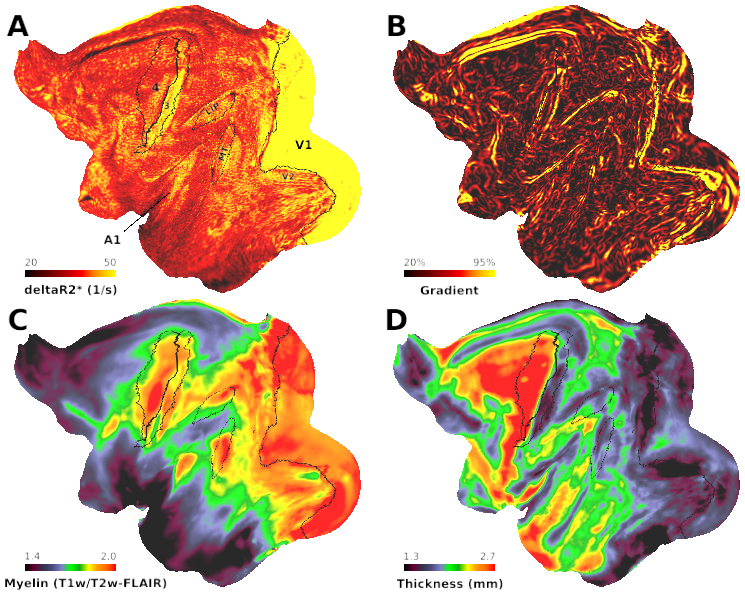
- Figure 4 - Variations in cerebral blood volume reveal cortical area boundaries.
- Figure 6 A-D - The anatomical determinants of cortical R2* and cerebral blood volume.
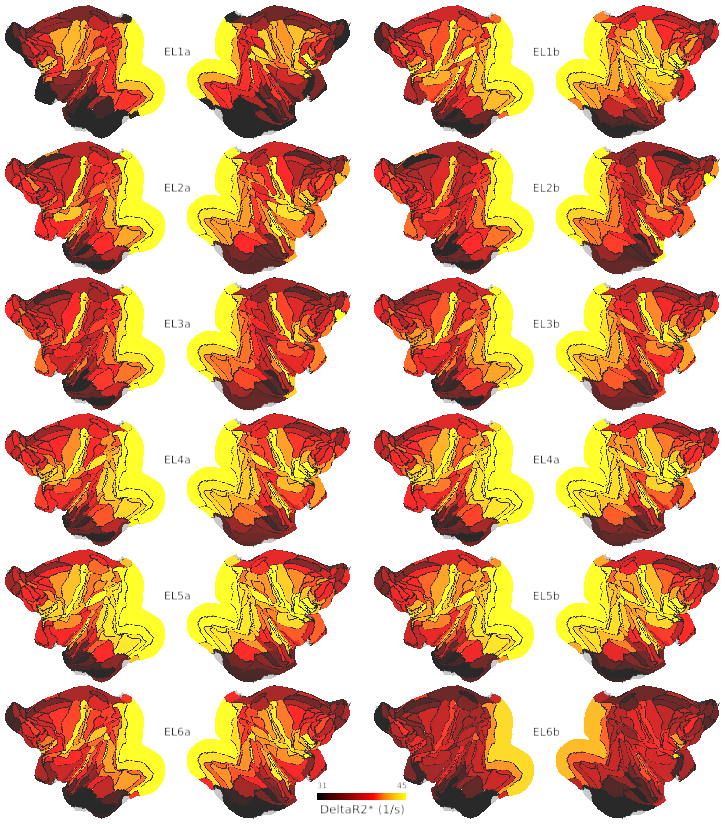
- Figure 3 - figure supplement 1 - Cerebral blood volume across equivolumetric layers.